01
Sensitive data
Customer documents and information must be processed through approved paths — not a personal account with no DPA and no retention control.
Elvaru Indonesia/Enterprise AI
Infrastructure, models and business solutions — running on our own hardware in Indonesia. One OpenAI-compatible endpoint, an audit record on every request, and no path from a prompt to the internet.
SourcesElvaru.ai measurement on our own GPU assets, 25 November 2026 — single stream, 1,400-token completions, median of 12 runs (507–1,070 tok/s); time to first token 225–2,269 ms. Short 128-token completions measure lower: 498–530 tok/s, 152 ms. Independent output speed: Artificial Analysis, DeepSeek V4.1 Flash with reasoning disabled, 10,000 input tokens, checked 22 October 2026. Evidence for a review; not an audit result and not a legal opinion.
Partnership
& powered by





01The business challenge
Enterprises need a clear path from experimentation to production. Three questions come up in every review, and each one has an answer you can test.
01
Customer documents and information must be processed through approved paths — not a personal account with no DPA and no retention control.
02
Teams need to connect AI requirements with actual capacity, quality and cost, instead of discovering the bill after the pilot.
03
Models must connect to the work and systems used every day, or the pilot never leaves the demo folder.
PositionElvaru connects business requirements with the right AI foundation: access, capacity, control and the evidence to explain it afterwards.
02Why Elvaru
Every claim on this page has a way to test it. None of it depends on believing a brochure.
01
The gateway writes one signed entry per request: the model that answered, the policy decision that allowed it, the token counts on both sides, the redaction summary and where it executed. Prompts and completions are not stored as content. Streaming chunks and tool calls close the same record.
Ask for one request ID on the call
02
Internet and tool access enters through the gateway as approved information only, evaluated per request. The runtime holds no direct egress. Managed, dedicated or on-premises, the same policy applies — and a denied call is logged with the rule that produced it.
Bring a workload you would never paste into a public chatbot
03
790 tokens per second sustained on a 1,400-token completion, with 295 ms to the first token, measured on our own GPU assets. Real output is long: a code file of 3,800 characters is about 1,060 tokens, so it finishes in roughly 1.3 seconds. Independent measurement places the runtime at 520 tokens per second on its harness, against 346 for the nearest comparable provider.
Run your own prompt while we watch
What we do not claimCertification, frontier-model parity on hard reasoning, or a number our own measurement page cannot support. Sources: Elvaru.ai measurement on our own GPU assets, 25 November 2026 — single stream, 1,400-token completions, median of 12 runs (507–1,070 tok/s); the earlier 31 October 2026 run on 128-token completions recorded 498–530 tok/s and 152 ms. Independent output speed: Artificial Analysis, DeepSeek V4.1 Flash with reasoning disabled, 10,000 input tokens, checked 22 October 2026.
03Portfolio
Choose the level of control and support your business needs — from an API call to your own GPUs.
Models ready to integrate through one OpenAI-compatible endpoint, with streaming, metering and an audit entry per request.
LiveRuntime licensing and support, with profiling and optimization of customer workloads on the hardware you already own.
By proposalGPU, runtime and models inside one boundary in Indonesia, managed by Elvaru, with prompt egress blocked at the gateway.
By proposalAgreed compute, network and storage for teams that want their own stack — with an upgrade path to managed serving.
By proposalAn action layer across CRM, ERP and enterprise systems, so AI output ends in a follow-up someone owns.
In developmentNoteThe portfolio follows Elvaru's business direction. Service availability, SKU specifications and SLA are set in the proposal. GPU-only capacity is not managed model serving.
04Model portfolio
DeepSeek answers today. The rest join the same OpenAI-compatible endpoint as they clear our evals: same gateway, same audit record, same redaction.
 Live
 In eval
 In eval
 In eval
 In eval
 In eval
 In eval
 In eval
Profiling, tuning and runtime support from Netra on the hardware we run — the same engine behind the published benchmark.
NoteVendor marks identify the model families and remain the property of their owners; a queued family is not a signed partnership. Availability follows each family's evaluation and the signed agreement.
05Netra runtime
Our inference runs on our own GPU assets and is optimized by Netra. Runtime licensing and support are available for customer workloads on the hardware you already own.
Model execution engine · own GPU assets in Indonesia · Exclusive Elvaru channel*
Measure prompt length, output size, concurrency, memory use and latency targets before tuning anything. No target, no change.
Batching, scheduling and serving configuration set against the targets that matter: throughput, p95 latency, or cost per workload.
Named support on the runtime you run, including upgrades and the measurement you need to explain the result internally.
DemoOne prompt, one file
Replay is slowed 8×. The readout keeps the real rate.
Illustrative output: a FastAPI risk-scoring service written to a single file, with a scoring model, validation and tests. Timing uses the measurement above — 790 tok/s sustained, 3.59 characters per token.
Note*Exclusivity follows the Netra agreement: territory, term and service rights to be confirmed. Output speed measured on Elvaru.ai's own GPU assets, 25 November 2026 (single stream, 1,400-token completions, median of 12 runs, 507–1,070 tok/s); independent comparison from Artificial Analysis, DeepSeek V4.1 Flash with reasoning disabled, checked 22 October 2026.
06Runtime benchmark
DeepSeek V4.1 Flash on our own 4× MI350X pod. Right is more total output for the whole system; up is faster decode for a single user. Batch work sits near c32; live chat sits near the left.
4× MI350X · DeepSeek V4.1 Flash · 15 Nov 2026
MethodDigitised from the benchmark chart published on elvaru.ai (15 November 2026), which labels the values approximate readings from a supplied image and notes that aggregate throughput and per-user numbers do not fully reconcile. Original logs and test conditions were not supplied; no supplied results exist above concurrency 32. Figures describe this pod, not a comparative hardware ranking.
07Data control
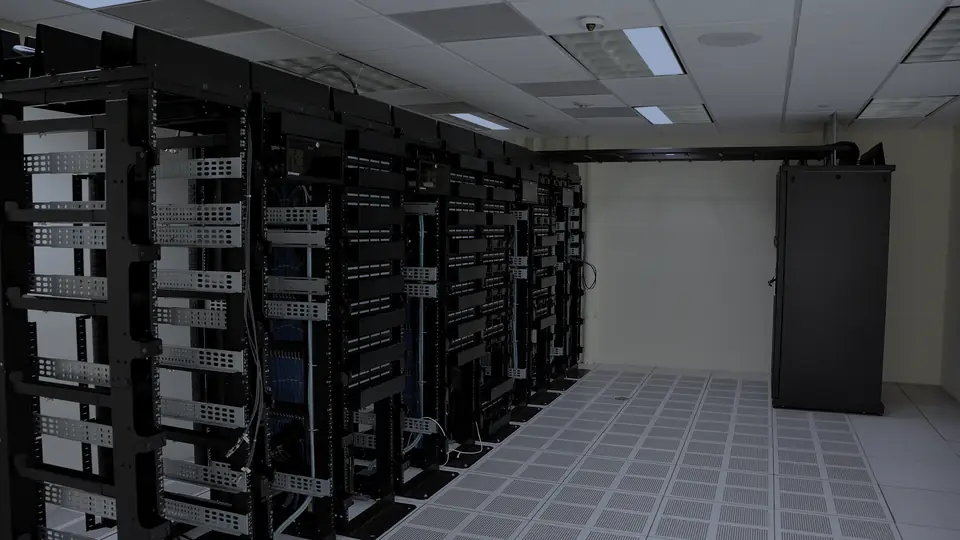
GPU, runtime and models inside one boundary — with no path for prompt data to reach the internet. Reference architecture, evaluated per deployment.
Approved information enters at the gateway only — checked per request.
Prompt egress is blocked at the boundary; the denial is logged with the rule.
ScopeReference architecture, not an audit result. Egress control depends on gateway policy, network rules and logging being configured and tested per deployment. Prompts, documents and responses stay inside the environment; access is logged as metadata, not raw prompt content.
08Data sovereignty
Three questions to guide enterprise AI evaluation — and the evidence to ask for alongside each answer.
Agreed controls. Reviewable evidence.
Where is data processed?
Map inference, documents, embeddings, cache, logs and backup separately. One inference location does not explain the whole data path.
Who can reach it, and for how long?
Identity, permissions, retention, redaction and subprocessors — plus the record that shows each decision was applied.
Which law can compel the provider?
Server location and corporate jurisdiction are different questions. The next section puts them side by side.
NoteConceptual illustration. Local processing supports data control but does not by itself prove compliance or legal immunity.
09Jurisdiction
Two services can both store data in Indonesia and still carry different jurisdictional exposure. That difference is worth asking about before a contract, not after.
Covered providers subject to US jurisdiction can be required to comply with legal process over data in their possession, custody or control — even when that data sits outside the United States.
The Personal Data Protection Law requires lawful and accountable processing. Article 56 allows cross-border transfer under tiered requirements — there is no blanket prohibition on all transfers.
Sources18 USC §2713 and US Department of Justice guidance; Law No. 27/2022 and PP 71/2019 on JDIH Komdigi. Business context, not legal advice. Assessment of a specific entity or deployment requires legal review.
10Product
The playground, usage and audit views are public product surfaces. Screenshots prove the appearance, not the result of a control audit.
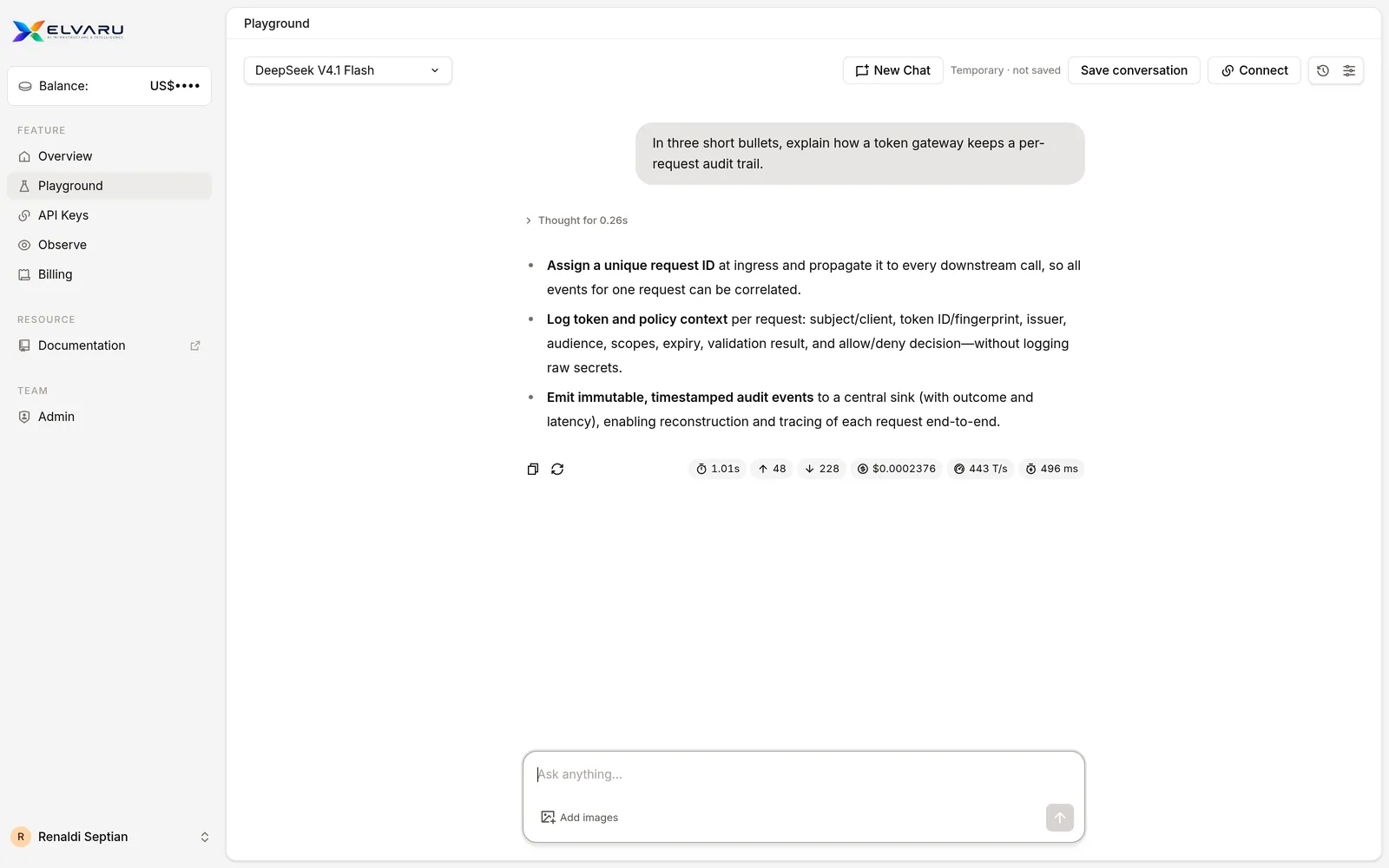
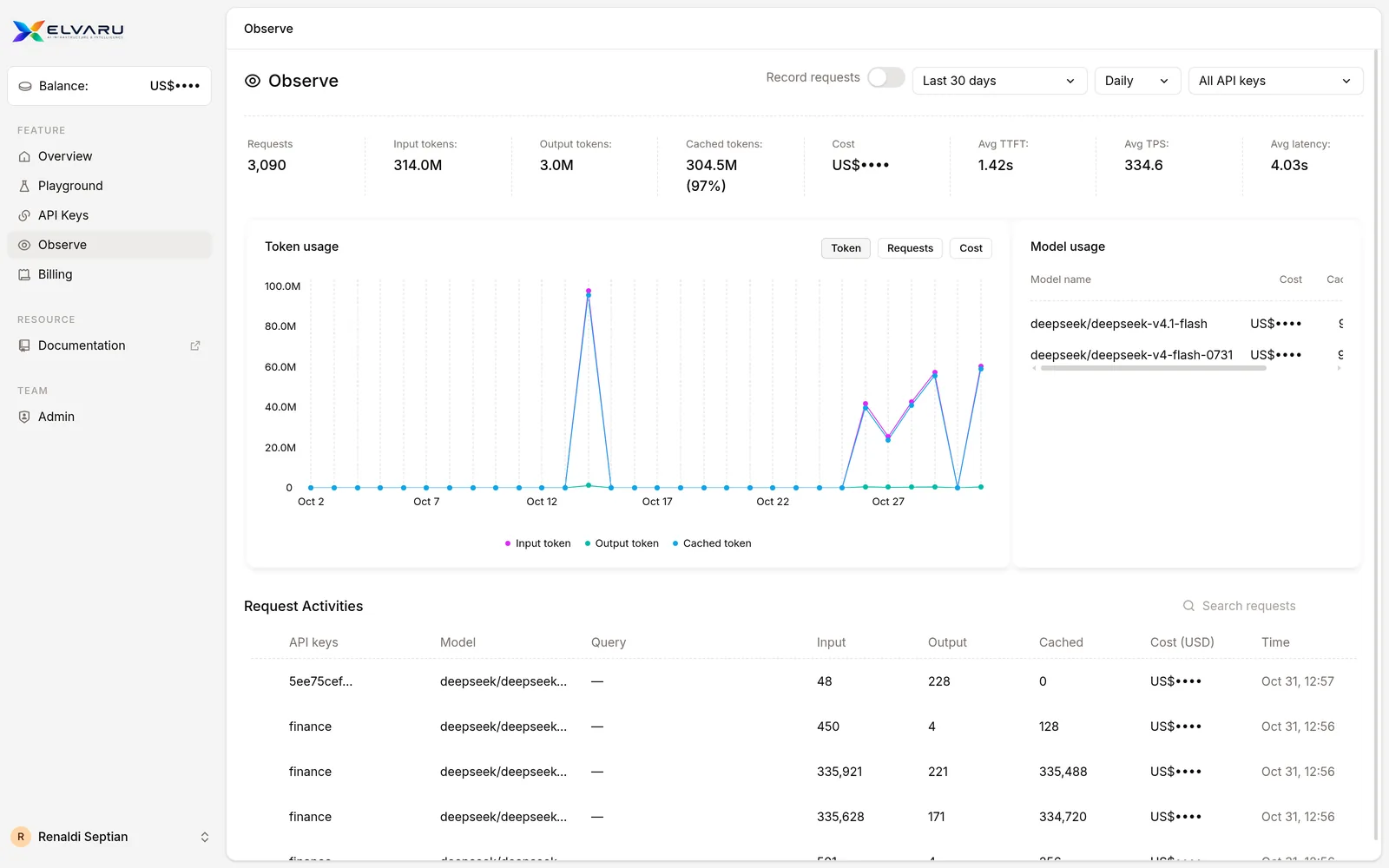
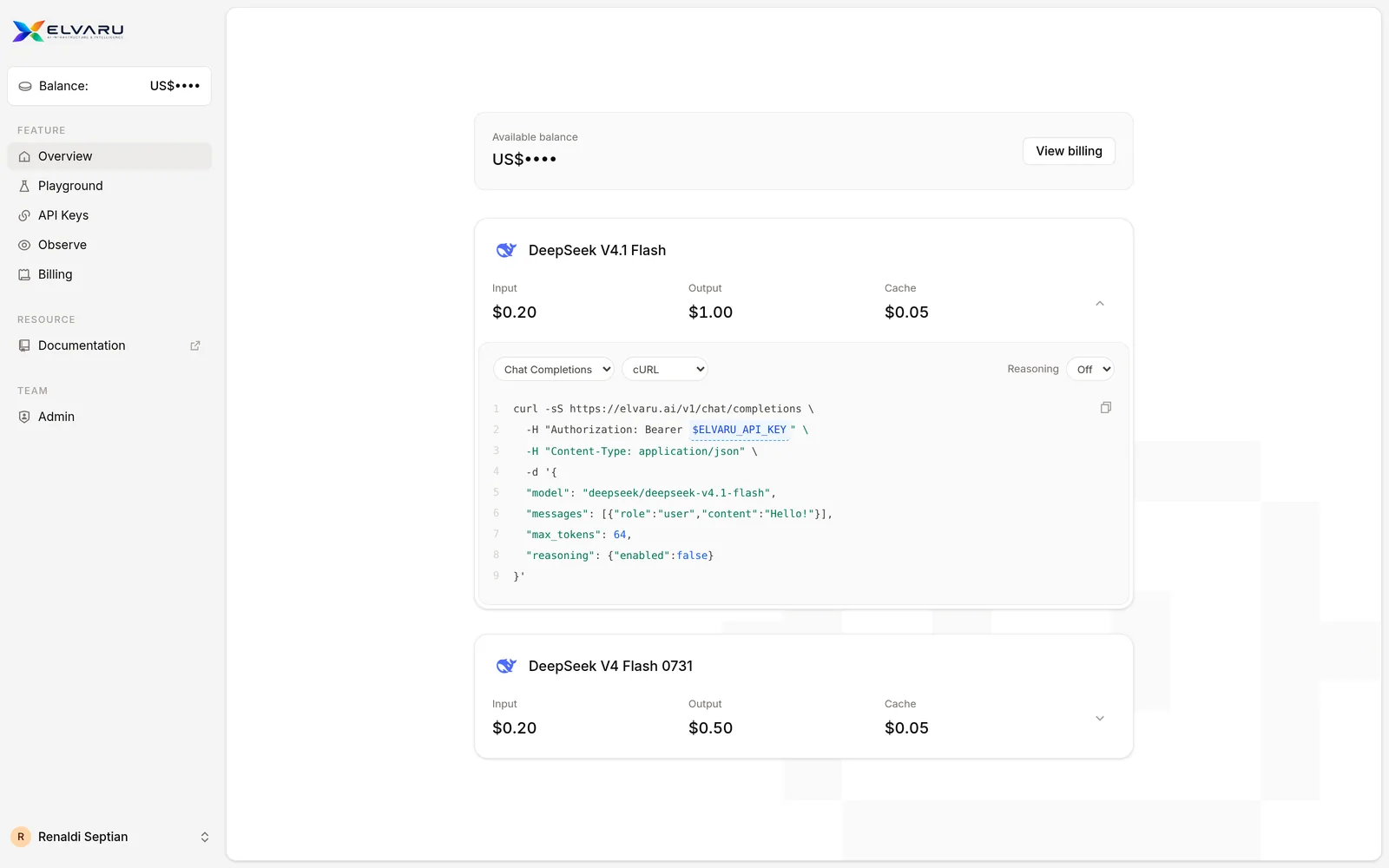
NoteNo customer accounts or private data were used in these captures.
11Pilot to production
A 30-day pilot with agreed business requirements and data controls. No production commitment until the numbers are on the table.
Select a use case, map the data, set a baseline and agree acceptance criteria with the people who own the process.
Integrate models through the gateway, test access permissions, response quality, latency and cost.
Review results, then set production capacity, SLA and the operating plan — or stop with the evidence in hand.
Bring the workload you would never paste into a public chatbot. We will show you the record it leaves behind.
NoteIndicative schedule. Legal readiness, technical controls, resources and service scope are prerequisites for production.