01
Personal accounts, corporate documents
Staff paste contracts and customer records into personal ChatGPT or Gemini accounts. No DPA, no retention control, nothing revocable.
Indonesia · own infrastructure
Elvaru is a token gateway for open-weight models. DeepSeek V4.1 and V4 run on our own infrastructure in Indonesia; GLM and six more families join the same OpenAI-compatible endpoint as they clear our evals — with redaction and an audit trail on every request.
01 / Context
Three failures show up in almost every enterprise review: data leaving on personal accounts, permissions that travel with the assistant, and compliance nobody can evidence after the fact.
01
Staff paste contracts and customer records into personal ChatGPT or Gemini accounts. No DPA, no retention control, nothing revocable.
02
The assistant inherits every folder its account can open; HR-only material becomes reachable, and nobody approved that path.
03
Auditors ask what personal data was processed by AI, where, and on what basis; the answer sits in individual inboxes.
Gateway
Apps & teams01
Product & engineering
Support & operations
Internal copilots
Any OpenAI-compatible client
Elvaru gateway02
PII redaction
Policy per role
Model routing
Immutable audit
Elvaru inferenceOPEN-WEIGHT
DeepSeek V4.1 · V4 on AMD Instinct MI350X, Indonesia. No third-party model provider sits in the path, so the full payload stays inside the deployment.
Models live: deepseek-v4.1-flash · deepseek-v4-flash-0731
Never leaves: full dataset, raw PII, credentials. Always recorded: request, model, policy decision.
02 / Platform
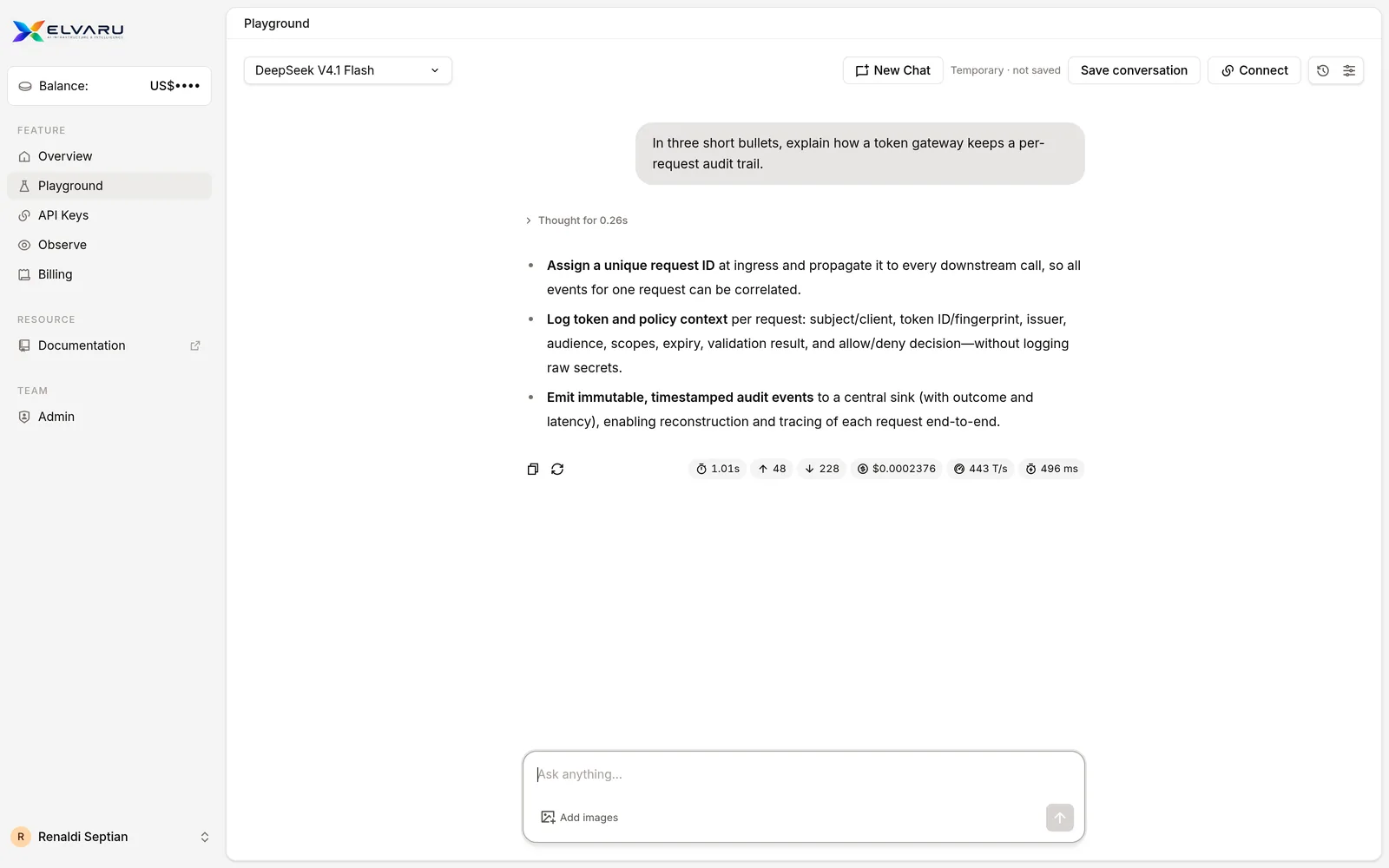
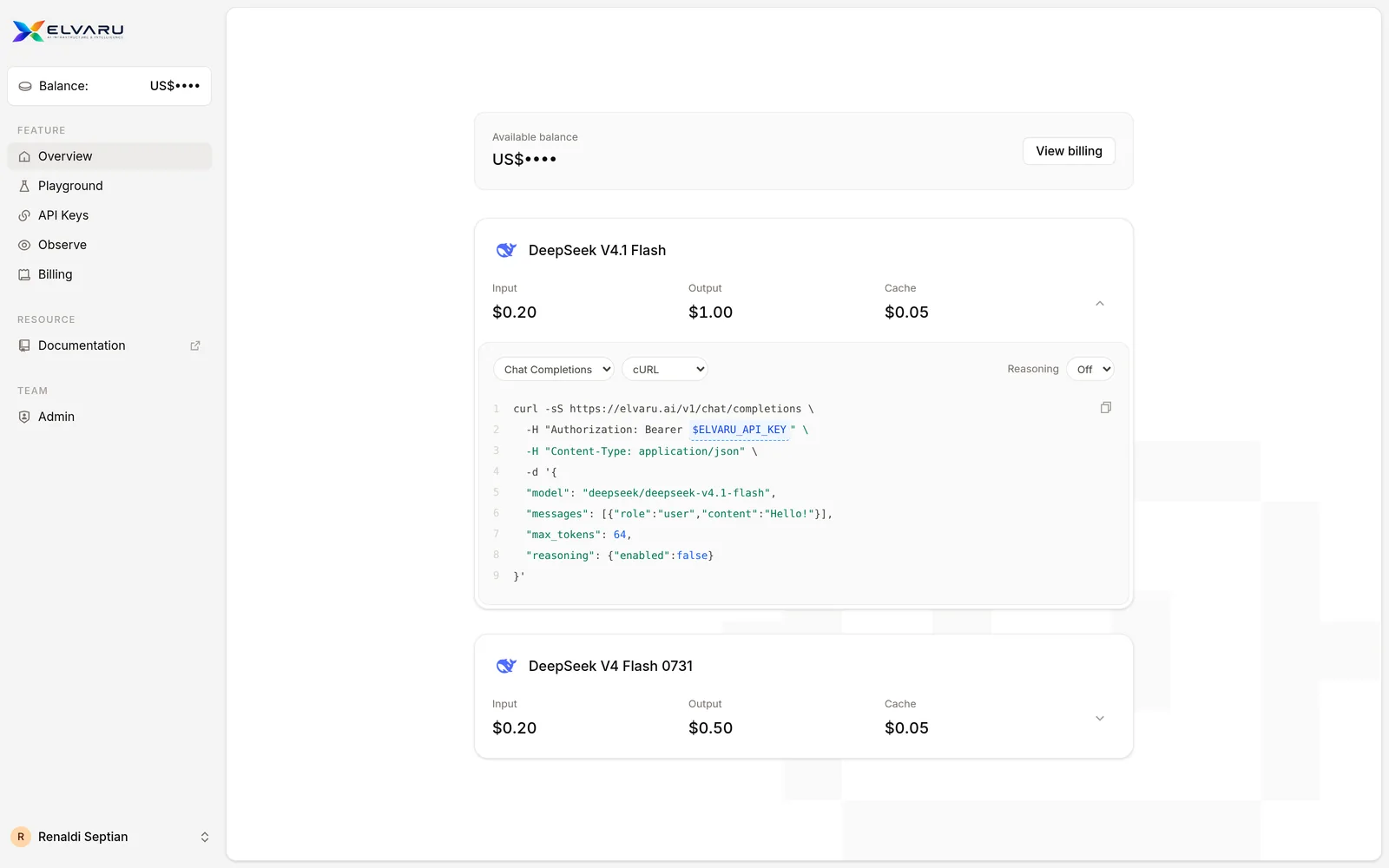
Screenshots from our own workspace, captured this month. Not a mockup, not a demo tenant.
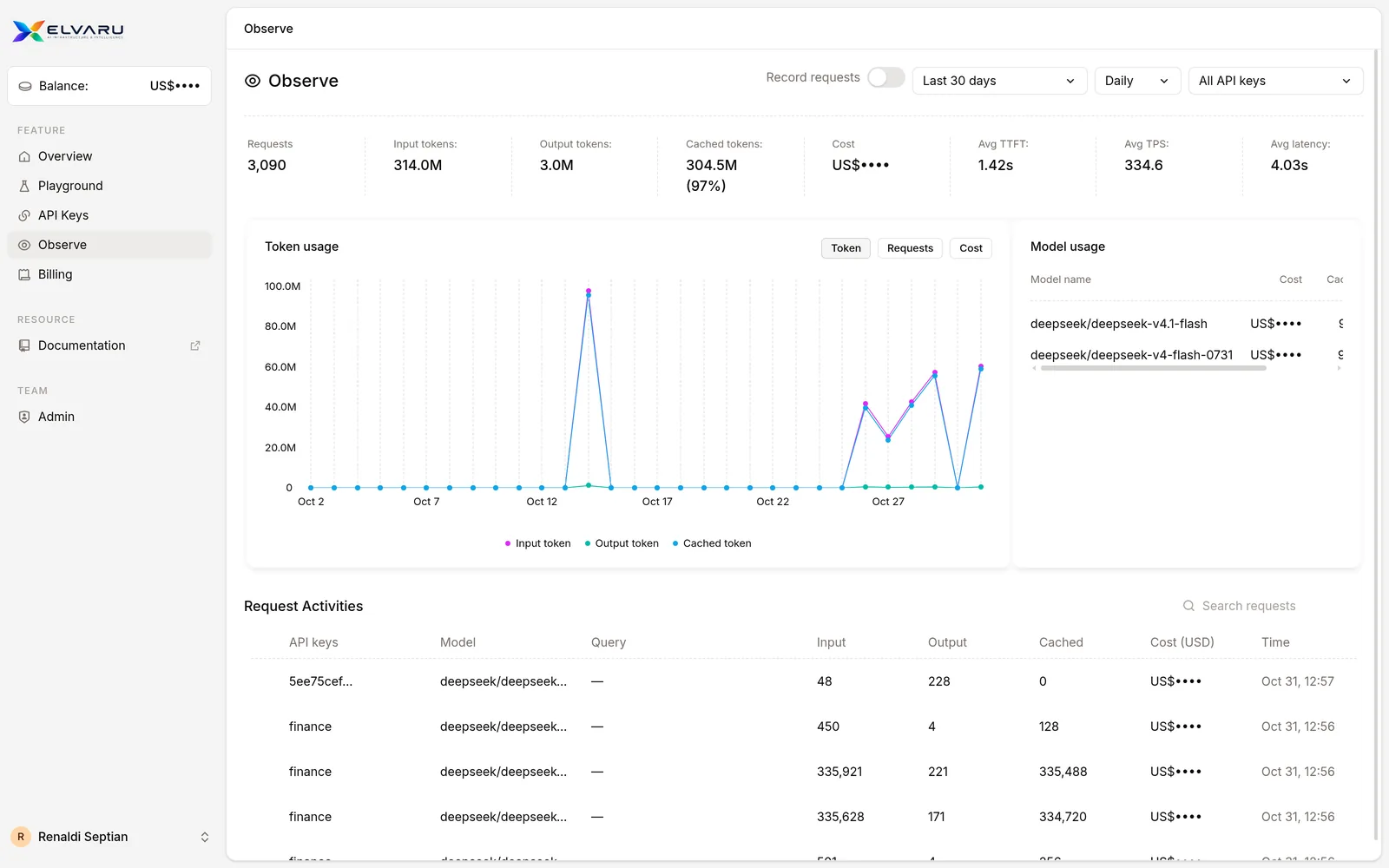
3,090
Requests
Trailing 30 days, our workspace
314M
Input tokens
Trailing 30 days, our workspace
97%
Cache hit
Trailing 30 days, our workspace
1.42s
Average TTFT
Trailing 30 days, our workspace
03 / Speed
Measured on our own deployment, not a datasheet: one stream, no batching tricks, on the same endpoint you call.
519tok/s
Median · 128-token completions · four runs
152ms
Median time to first token · 19 runs
1024tok in 2.1 s
Long completion, single stream · no decay
Measured 31 Oct 2026 · DeepSeek V4.1 Flash · single stream, concurrency 1 · 19 runs, 121–163 ms TTFT
03 / Models & pricing
One OpenAI-compatible endpoint for every family we serve. What is live answers today; what is queued joins the same API as it clears our evals.
V4.1 Flash · V4 Flash 0731
Vision on V4.1, reasoning traces, tool calls, structured outputs and streaming.
Zhipu AI · GLM series
Reasoning, tool calls and long-form drafting, joining the same audited endpoint once it clears our evals.
Request early accessAlibaba · Qwen series
Dense and MoE sizes, strongest on multilingual text and code.
Request early accessXiaomi · MiMo series
Reasoning-first small models built for agent loops and tool use.
Request early accessMoonshot AI · K series
Agentic family tuned for long-horizon work and heavy tool use.
Request early accessMiniMax · M series
High-throughput MoE family with cheap long-input inference.
Request early accessMeta · Llama series
The open-weight baseline, with the widest tooling and fine-tune ecosystem.
Request early accessMistral AI · Large / Medium
Efficient European family, with Apache-licensed tiers.
Request early accesselvaru.ai/v1
| Model | Capabilities | Input / 1M | Output / 1M |
|---|---|---|---|
|
deepseek/deepseek-v4.1-flash V4.1 Flash |
Reasoning · tools · structured outputs · streaming |
US$0.20 |
US$1.00 |
|
deepseek/deepseek-v4-flash-0731 V4 Flash 0731 |
Tools · structured outputs · streaming |
US$0.20 |
US$0.50 |
Cached read US$0.05 per 1M tokens on DeepSeek. List price per 1M tokens, active on elvaru.ai/v1.
Point an existing OpenAI SDK at the endpoint and swap the model string. Streaming, tool calls and structured outputs behave the same way.
Read the quickstartcurl https://elvaru.ai/v1/chat/completions \
-H "Authorization: Bearer ***" \
-H "Content-Type: application/json" \
-d '{
"model": "deepseek/deepseek-v4.1-flash",
"messages": [
{ "role": "user", "content": "Summarise this contract in five bullets." }
]
}'05 / Evidence
CDNA 4 · TSMC 3nm · 185B transistors · 256 MB Infinity Cache · ROCm · vLLM / SGLang
288GB
HBM3E per OAM
8TB/s
Memory bandwidth
9.2PFLOPS
MXFP4 / MXFP6, dense
1,000W
Air-cooled OAM
Memory per card decides what model fits without costly tensor-parallel sharding. 288 GB of HBM3E per OAM means a large open-weight model serves from a single device, so you are not paying interconnect tax for the privilege of running it.
FP4 and FP6 support is the other half of the economics: lower precision cuts cost per token without changing the API you call. We publish what the hardware actually did, not a peak number from a datasheet.
Internal benchmark, DeepSeek 4.1 Flash. Comparative results use different benchmark harnesses/workloads; not an apples-to-apples hardware comparison. Explore the measured curves.
Inference benchmark
DeepSeek 4.1 Flash · 4× MI350X, 2× B300, and 4× B300
Approximate values digitized from a supplied chart
Right means more total output for the whole system; up means faster decode for one user. This chart does not measure time to first token or end-to-end latency.
4× MI350X
≈5,060tok/s aggregate
≈180 tokens/s per user
Concurrency 32
No data in supplied chart
2× B300
≈2,870tok/s aggregate
≈120 tokens/s per user
Concurrency 32
No data in supplied chart
4× B300
≈2,500tok/s aggregate
≈100 tokens/s per user
Concurrency 32
No data in supplied chart
Comparative results use different benchmark harnesses/workloads; not an apples-to-apples hardware comparison.
Values are approximate readings from a supplied image. Original benchmark logs and full test conditions have not been provided.
Marked in code as dataStatus: "approximate_from_image". Replace it with verified
raw logs before making any validated performance claim; until then the numbers are
approximate readings, not measurements produced by this site.
| GPU configuration | Concurrency | Aggregate throughput (tokens/s) | Per-user decode speed (tokens/s) |
|---|---|---|---|
| 4× MI350X | 1 | ≈1,030 | ≈1,150 |
| 4× MI350X | 4 | ≈1,980 | ≈600 |
| 4× MI350X | 8 | ≈2,400 | ≈390 |
| 4× MI350X | 16 | ≈3,360 | ≈270 |
| 4× MI350X | 32 | ≈5,060 | ≈180 |
| 2× B300 | 1 | ≈420 | ≈500 |
| 2× B300 | 4 | ≈880 | ≈360 |
| 2× B300 | 8 | ≈1,590 | ≈250 |
| 2× B300 | 16 | ≈1,820 | ≈150 |
| 2× B300 | 32 | ≈2,870 | ≈120 |
| 2× B300 | 64 | ≈3,660 | ≈80 |
| 2× B300 | 128 | ≈5,180 | ≈60 |
| 4× B300 | 1 | ≈510 | ≈610 |
| 4× B300 | 4 | ≈1,070 | ≈380 |
| 4× B300 | 8 | ≈1,630 | ≈270 |
| 4× B300 | 16 | ≈1,900 | ≈160 |
| 4× B300 | 32 | ≈2,500 | ≈100 |
| 4× B300 | 64 | ≈2,940 | ≈60 |
| 4× B300 | 128 | ≈2,330 | ≈20 |
06 / Data Sovereignty & Compliance
Data sovereignty covers where processing happens, who can access the data, and which laws apply to the provider. These factors are essential when evaluating AI for sensitive business information.
A
Running inference in Indonesia reduces the need to send sensitive prompts and documents to AI services abroad.
B
Assess the whole service path — from application and gateway through models, logs and backups — so you know where data is processed and stored.
C
Access rights, retention periods, deletion, and any use of data for model training belong in clear policy and terms of service.
D
Server location should be weighed together with the provider's legal entity, its supporting parties, and their authority over customer data.
Jurisdiction
Hosting in Indonesia answers one question: where the disks are. It does not answer who can compel the operator to hand data over. The US CLOUD Act is the clearest example of why that second question decides enterprise risk.
Two deployments, two disclosure regimes
US Department of Justice — CLOUD Act resourcesElvaru — operated in Indonesia
Provider subject to US jurisdiction
How the statute works, in business terms — not legal advice, and not a claim about any specific vendor. Two providers can both keep data in Jakarta and still answer to different disclosure regimes.
What the platform produces is evidence. It supports governance work; it does not replace it.
Per-request logs can supply the input a record of processing activities needs. They do not replace the record itself.
Per-request lineage helps document high-risk processing during an assessment. The assessment stays with the controller.
Logs help narrow an incident to affected requests, which supports investigation. They do not by themselves discharge notification duties.
Inference location is recorded per request. Inference location alone does not prove that logs, backups, telemetry and supporting services all sit in Indonesia.
Regulatory context
UU PDP No. 27/2022 has applied in full since 17 October 2024; PP 33/2026 sets out its implementing rules. The maximum administrative fine is 2% of annual revenue, applied to the violation variable (Article 57, UU 27/2022).
Elvaru does not claim certification. Governance support here means logs, policy decisions and execution location that a ROPA or DPIA review can draw on. Business context, not legal advice.
07 / Questions
Short answers, no brochure language. Anything missing, ask on the call.
Same API shape, different default: prompts and data stay on our hardware in Indonesia and every call is logged. There is no third-party model provider in the path — the endpoint you call runs DeepSeek on Elvaru infrastructure, so the data-handling question has one answer.
DeepSeek V4.1 with reasoning, tool use and structured output covers most enterprise workloads: drafting, extraction, classification, code. We publish per-turn telemetry — 152 ms to the first token and 519 tok/s on a single stream — so you judge with numbers, not a leaderboard.
Yes. Trailing 30 days in our own workspace: 3,090 requests, 314M input tokens, 97% cache hit, 1.42 s average TTFT. The screenshots above come from that workspace — not a demo tenant, not a mockup.
We do not claim certification. Elvaru produces the evidence your DPIA and ROPA need: per-request logs, model and policy decisions, and where each request executed. Certification is a separate, evidence-based review. Business context, not legal advice.
US$0.20 per 1M input tokens. Output is US$1.00 on V4.1 and US$0.50 on V4; cached reads are US$0.05. There is no platform fee to start, and the US$250 credit covers roughly 962M blended tokens.
Thirty minutes with an engineer, not a sales script. Bring one workload you would never paste into a public chatbot, and we will route it in front of you.